Home About Work With Me Results Course Start Here Apply to Work Together
Sales · Business Strategy · Marketing

Selling
with heart.

You got into this work to help people — not to feel like you're hustling them. But staying quiet about what you offer isn't really working either, is it. There's a way to sell that feels like a natural extension of who you already are, and this is it.

"You're not in the business of convincing people. You're in the business of making it easy for the right people to find you."

Ashley Chymiy
The Reframe

Your job isn't to convince.
It's to be so clear that the right people recognize themselves.

Most of us who dread selling were exposed to a version built on convincing — turning someone uncertain into someone sure through urgency, pressure, and engineered FOMO. It works, technically. And it feels awful for everyone.

Heart-centered selling is built on clarity instead. Your job isn't to convince anyone of anything — it's to be so clear about who you're for, what you offer, and what becomes possible, that the right people recognize themselves in your work and the wrong people gracefully move on.

When you're that clear, you're not pushing at all. You're just making it easy for the person who's already looking to find the door — and step through it on their own terms.

The most generous thing you can do for someone who needs what you offer is to make sure they can actually find it.
How to Sell With Heart

Six approaches that feel aligned

If the reframe is the why, these six are the how. Not tactics you perform — just ways of showing up that build trust so naturally, that by the time you make an offer, saying yes feels like the most obvious next step in the world.

01

Lead with your why, not your offer

Nobody wakes up wanting to buy a coaching program. They wake up wanting to feel less stuck. When you lead with why you do this work — what you genuinely believe is possible for people like them — you're not selling anymore. You're inviting them into something.

The offer is the door. But the belief is what makes them want to walk through it. Share a conviction before you ever mention what you sell, and watch how differently people respond.

Try It
Write a few sentences about why your work matters — not what it is. What would you fight for? Share one of those convictions this week, before mentioning anything for sale.
02

Tell stories, not statistics

Your credentials tell someone you're qualified. A story tells them you understand. And understanding is what actually earns trust. The moment a potential client reads something you've shared and thinks "that's exactly where I am" — you have her in a way no bio can match.

The stories that do this aren't the polished wins. They're the before — when you were tired, confused, or stuck in the same place she's in right now. Share those, and watch them become a mirror.

Try It
Think about a moment when you were exactly where your ideal client is now. What happened? What shifted? Write it and share it.
03

Give real value before you ask for anything

The best sales relationships are built long before a sales conversation happens — through content that genuinely helps, through showing up consistently enough that your audience develops a real sense of how you think.

A client who's learned something real from your free content — who's actually used your perspective and had it work — has already decided. They're just waiting for the right moment to step forward. Give them something worth using. Not a teaser. Not a tip that requires them to buy the rest. Real insight, genuinely offered, no strings.

Try It
What's one genuine insight that would help your ideal client see their situation differently? Share it this week, with no ask attached.
04

Let your clients speak for you

Right before clicking buy, almost every person does the same thing: they look for someone who was once exactly where they are and can report back on what happened next. That's not a lack of trust in you — it's just how humans make decisions. They want proof that the leap is worth it.

The testimonials that work aren't vague compliments. They're specific before-and-afters: here's where I was, here's what shifted, here's what became possible. That specificity is what makes a reader think: that could be me.

Try It
Pick your most powerful testimonial — the one that best captures the transformation — and share it this week with context about why it means something to you.
05

Show the real behind-the-scenes

There's a certain kind of perfectly curated feed that makes you feel vaguely worse about yourself while you scroll through it. Highlight reel content doesn't build trust — it creates distance. People sense when nothing is ever hard for someone, and it makes them feel unseen.

What actually builds trust: showing the work. The challenge you're navigating. The thing that didn't go as expected. The lesson you're still sitting with. Not to be vulnerable for its own sake — but because honesty creates connection in a way polish never will.

Try It
What's something real you're navigating right now that your ideal client could relate to? Share it honestly — not for vulnerability's sake, but because true things connect.
06

Lead with the solution, follow with the offer

Most selling fails at the first step: it leads with the offer instead of the problem. "Here's what I sell" before "here's why you're stuck" asks for trust before you've earned it — and people feel that gap.

Flip it. Start with the honest diagnosis — what's really causing the struggle, probably something your industry isn't saying out loud. Give that away freely. Then, naturally, mention that you have a way to help people apply it. By then, the offer isn't a pitch. It's a logical next step.

Try It
What's the problem your core offer solves, and what's your honest take on the root cause? Share your perspective on the problem this week, before mentioning the solution.
Ashley Chymiy
The Shift

Staying quiet about what you offer isn't modesty. It's the people who needed you not finding you.

I spent years telling myself I was being thoughtful by not promoting my work too much. What I was actually doing was making it impossible for the right people to find me.

You don't have to be loud. You don't have to be aggressive. You just have to show up consistently enough that the person who needs exactly what you offer — the one who's been looking — can actually find it.

find your natural approach
When It's Not Working

A good offer that isn't moving?
Here's the honest diagnostic.

I know what it feels like to launch something you've poured everything into — and watch the sales come in at a fraction of what you expected. I was ready to scrap the whole thing until someone I trusted looked at it and said: the offer is excellent. The problem is how you're marketing it.

When a genuinely good offer doesn't sell, the reason is almost always one of five things.

1

Your audience hasn't seen it enough

People need to see an offer 5–7 times before buying. If they're catching 20–30% of your content, you may need 15–20 mentions before it's registered that many times. You're keenly aware of every mention. They've barely noticed.

The FixPlan at least a dozen mentions, approaching from different angles each time — different benefits, client stories, aspects of the transformation. You're not repeating yourself. You're reaching people who missed it.
2

It's not landing emotionally

By the time we're consciously weighing an offer, we've usually already decided at a gut level. The rational evaluation is mostly justification. If your messaging leads with features and deliverables rather than how your client will feel, it's skipping the part of the brain that actually decides.

The FixLead with the emotional outcome, back it up with practical details. How does your client feel before finding you? How does she want to feel instead? Make sure your offer speaks to that gap first.
3

The value isn't clear

Most people over-explain features (six sessions, worksheets, a private community) and under-explain benefits — what life actually looks like on the other side. Your client doesn't care about the number of sessions. She cares about what she'll be able to do, feel, or have that she can't now.

The FixRewrite your offer to lead with outcomes: what changes, what becomes possible, what stops being a struggle. Sell the destination. Let the process be a footnote.
4

There isn't enough trust yet

A person can love your content and still not buy, because they don't yet trust you can deliver what you're promising. That's not a judgment — it's just how trust works: slowly, through accumulated evidence.

The FixInvest in your audience before asking anything of them. Show up with genuinely useful content. Share specific testimonials. Give people enough of a window into how you think that they can picture what working with you would be like.
5

The path to purchase is too complicated

If someone has to leave the platform, navigate to your website, find the right page, and fill out a long form just to express interest — you'll lose people at every step. Not because they changed their minds. Because the friction was too high.

The FixTrace the path from "I'm interested" to "I've purchased." Count the steps. Cut everything non-essential. One clear action, one obvious link, one simple next step. Make it easy for a "yes" to actually happen.

Selling with heart: at a glance

Keep this somewhere visible. The next time selling feels hard, one of these is usually what's missing.

The approach

Lead with your why — conviction before offer
Tell turning point stories, not polished success reels
Give real value with no strings attached
Let client testimonials do the convincing
Show the honest behind-the-scenes
Lead with the solution, follow with the offer

If your offer isn't moving, check:

Are you talking about it enough? (Aim for 12+ mentions before reassessing)
Is it landing emotionally, or just logistically?
Is the value clear — outcomes first, features second?
Have you built enough trust for a purchase to feel safe?
Is the path to purchase as frictionless as possible?
  The Bottom Line

The person who needed you most is out there right now, looking. Make it easy for her to find you.

Selling with heart isn't a technique. It's a decision to believe that what you offer matters enough to say so — clearly, consistently, in a way that's true to who you are. Not once. Not when it feels comfortable. But often enough that the right people finally hear it.

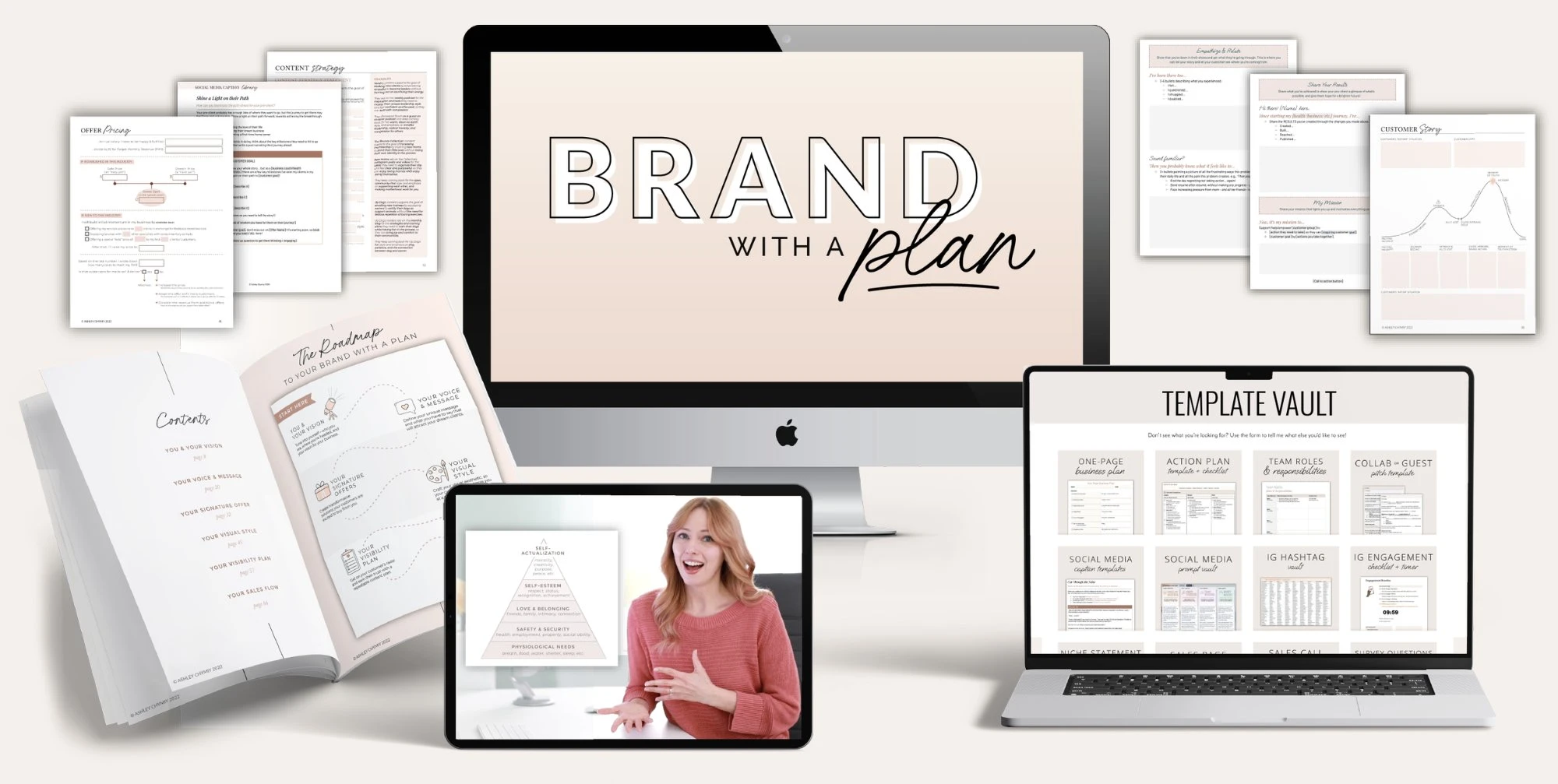
Brand With A Plan course
Take it further

The complete sales system is inside Brand With A Plan

Module 6 covers your full Sales Flow — the same principles behind every approach in this guide, built into a step-by-step system you can use right away. With templates for every stage, so you're never starting from a blank page.

Module 6: Your Sales Flow — full customer journey
Sales page copy templates + sales call structure guide
Launch planning toolkit + sales funnel templates
Explore BWP Work 1:1 with Ashley